She qualified for a mortgage after divorce, but the monthly budget told a different story.
Or so she thought.
This is a composite illustration drawn from patterns I have seen repeatedly in my work with divorcing women in Texas. Details have been changed to protect privacy.
The Setup
She was forty-seven years old. She had worked as an emergency room nurse for nineteen years. She was two months from a final divorce decree and facing a decision she had been dreading: whether she could afford to buy her own home.
The marital home was being sold as part of the settlement. They had agreed on that early and without much conflict — neither of them wanted to fight over staying in a house that held so much of a marriage they were ending. Her share of the equity would give her a down payment. The question was what came next.
She had found a townhome. Quiet neighborhood. Good school district for her youngest, who was fourteen and still at home. The purchase price was $385,000. With her down payment and closing costs accounted for, her loan amount would be approximately $340,000.
She had looked up a mortgage calculator online. The number had stopped her.
“I don’t think I can do this,” she told me in our first conversation. “I don’t think I can afford it.”
I asked her to walk me through how she had arrived at that.
She had not. She had looked at the payment estimate, compared it to what she vaguely thought she spent every month, and concluded the gap was too wide. She had not sat down with her actual numbers. She had made a decision — or nearly made one — based on what she feared was true rather than what was true.
What It Means to Be Qualified for a Mortgage After Divorce
Her income was the first thing we addressed.
She was a W2 employee, which simplified the income documentation considerably. But her pay was not fixed — it depended on which shifts she worked, how many hours, whether she had picked up overtime. Some months her gross income was $8,200. Other months, during stretches of scheduled time off or lighter shifts, it was closer to $6,800.
That variability is exactly what makes nurse income both real and complicated at the mortgage table.
Lenders do not take her best month. They do not take her current schedule. They average her last 24 months of W2 income, including any overtime and shift differentials, and use that figure as her qualifying income. Her 24-month average worked out to $7,600 gross per month.
Her existing monthly obligations:
— Car payment: $380
— Credit card minimum payments: $95
— No student loans outstanding
Total existing monthly debt: $475
Back-end DTI ceiling at 43%: $7.600 × 0.43 = $3,268 maximum total obligations
Available for housing: $3.268 − $475 = $2,793
Total housing payment on the $340,000 loan in North Texas:
— Principal and interest: $2,113
— Property taxes (est. 1.1% of purchase price): $353
— Homeowners insurance (est. 1%): $321
— Total PITI: $2,787
She qualified for a mortgage after divorce. But just barely. The DTI had almost no room.
The bank would say yes. The question she had not been able to answer was whether she — not the lender — could actually live inside that number. There was no room for emergencies or the unexpected.
The Budget She Had Never Written Down
She had been managing money her whole adult life without ever writing out a budget. During her marriage, her husband had handled the finances. After the marriage, she had been covering her portion of the split expenses while still in the marital home, staying above water but not tracking anything closely.
“I know I spend money,” she told me. “I just don’t know exactly where it goes.”
That is the honest version of a sentence I hear regularly. And it is the reason the qualification number — the lender’s yes — had not given her the clarity she needed.
We built her budget from scratch. Sixty days of bank statements. Every credit card statement for the same period. Not an estimate of what she thought she spent. The actual numbers.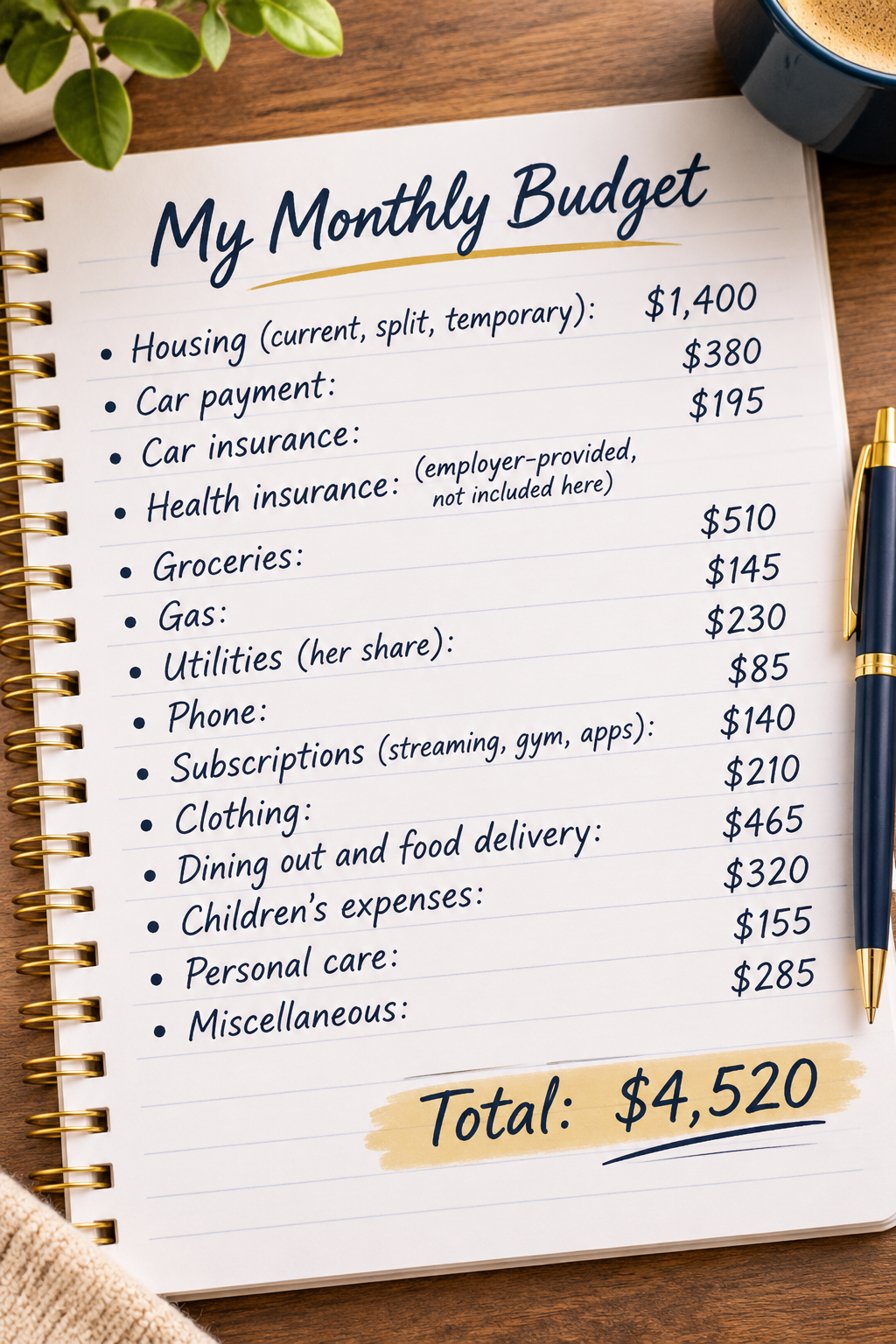
What we found surprised her.
Her take-home pay after taxes averaged approximately $4,950 per month on her averaged income.
She had been spending $4,520 on a temporary, shared-expense basis — and she had approximately $430 left over each month. That felt tight because it was tight. It had not left her insolvent. But it had not left her much.
The question was what happened to that picture when she moved into her own home and the housing cost changed.
What the Numbers Actually Showed
The mortgage payment would replace the $1,400 she was currently contributing to shared housing. The new number was higher. But here is what the budget review also revealed:
$465 in dining out and food delivery. Month after month, without thinking about it — coffee orders, lunch pickups on shifts, Thursday-night dinner because she was exhausted after a twelve-hour shift and did not want to cook.
$140 in subscriptions she had not evaluated in two years. Four streaming services. A fitness app she had downloaded during the divorce and never opened. A monthly box she had signed up for and forgotten.
$210 in clothing — some of it genuinely needed, some of it stress shopping during the worst months of the divorce process that she recognized immediately when she saw it on paper.
She sat with the statement printouts for a long time. She was not ashamed of what she saw. She was relieved. Because for the first time, she was looking at her actual financial life instead of her feared version of it.
“I had no idea,” she said. “I really thought I was barely surviving. Instead, I was throwing money away.”
The math looked different once she knew the numbers.
What the Revised Budget Showed
With intentional adjustments — not punishing ones, not a deprivation budget, but a budget that reflected actual choices — her picture shifted significantly:
Dining out and food delivery: reduced to $220 (still generous, realistic for a nurse working long shifts)
Subscriptions: reduced to $65 (two streaming services, no others)
Clothing: reduced to $100 (a planned allowance rather than reactive spending)
Those three changes freed approximately $430 per month — additional, without touching anything else in the budget.
New housing cost: $2,787 / month (PITI)
Previous shared housing contribution: $1,400
Housing difference: $2,767 − $1,400 = an additional $1,387/month
The housing increase was real. But combined with her actual take-home of $5,550 and the $430 she recovered from intentional spending adjustments, her revised monthly picture was workable. She was not squeezing. She had room — not a lot, but enough to fund a small emergency reserve and begin rebuilding the retirement contributions that had gone dormant during the divorce.
She was not barely surviving. She was spending without intention, and she was doing it during the most disorienting season of her adult life. Those are not the same problem.
What She Needed That She Did Not Have
What she needed was not a bigger income. She had a good income. What she needed was to see her numbers — clearly, honestly, without judgment — so she could make a decision based on reality rather than anxiety.
She had been ready to walk away from the townhome. She had been ready to rent for another two years while she “figured out her finances” — meaning while she continued to not look at them closely.
The budget did not solve her life. It gave her permission to live it.
She closed on the townhome six weeks after we built the budget together. The payment fit. The reserve account started. Her youngest is still in the school district she chose.
“I kept telling myself I didn’t know what my numbers were,” she said. “The truth was I was afraid to look. The numbers turned out to be a lot less scary than the not-knowing.”
RELATED READING
One-Income Mortgage Qualification After Divorce — What the Lender Actually Looks At
Budget After Divorce — How to Build One That Actually Works on One Income
Can I Afford to Keep the House in My Texas Divorce?
Pay Off Debt First — or Save for a Down Payment After Divorce?
House Rich, Cash Poor After Divorce — Why Home Equity and Liquid Assets Are Not the Same Thing
She qualified for the mortgage. She just did not know yet whether she could afford the life around it. The budget is what told her the truth — and the truth turned out to be better than what she had been carrying in her head.
If you are standing in the gap between “the lender might say yes” and “I don’t actually know if I can afford this” — that gap is exactly what the Divorce Clarity Session is built to close.
The qualification gets you to the table. The budget tells you whether you can stay there. If you are buying or refinancing after divorce and want someone to run both numbers with you — not just the approval, but the real monthly picture — that is the conversation this page is built around.
Elizabeth Rose is a Certified Divorce Lending Professional and licensed mortgage professional serving women throughout Texas with 29+ years of experience in real estate, mortgage, and financial services. She is also a retirement strategies and annuities strategist, and the author of Sister, Own Your Finances. Elizabeth helps women navigate the financial decisions that carry the most weight — by design, not default. NMLS# 252686 | NPN# 19058858